

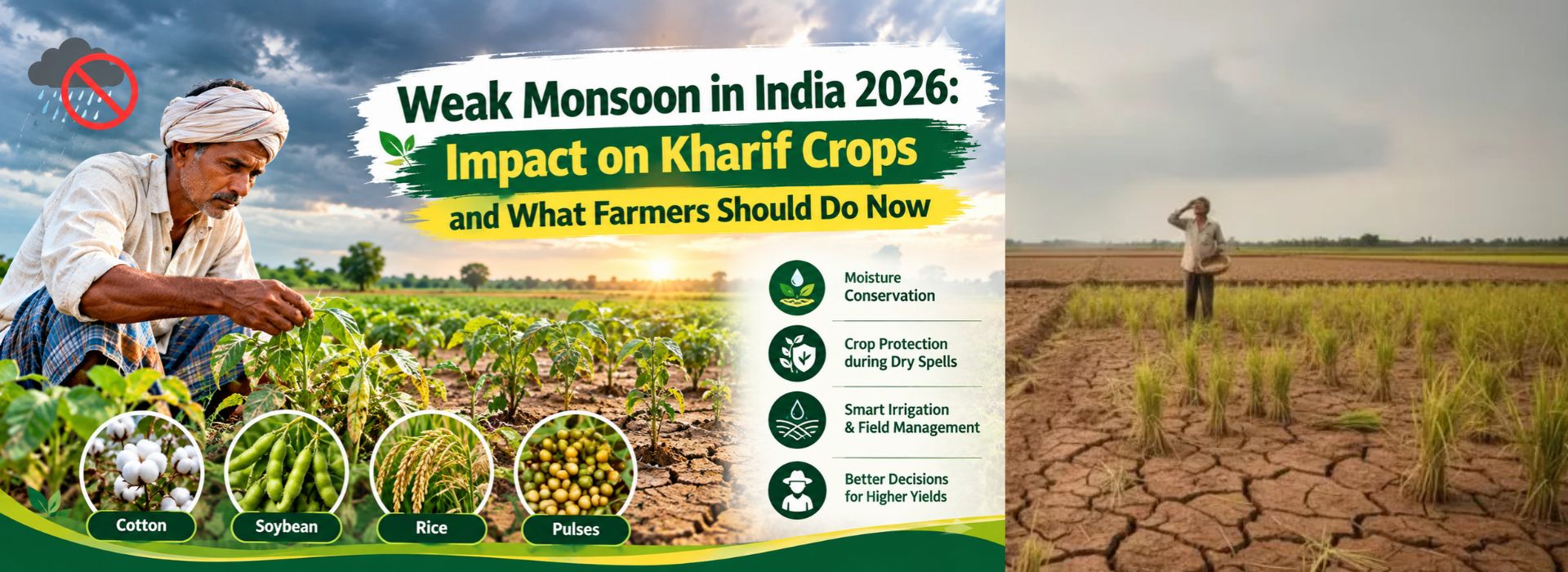
Weak Monsoon in India 2026: Impact on Kharif Crops and What Farmers Should Do Now
September 22, 2026Weak Monsoon in India 2026: Impact on Kharif Crops and What
Farmers Should Do Now
India’s 2026 southwest monsoon
has created significant challenges for farmers in several parts of the country.
Uneven and below-normal rainfall, followed by dry spells in September, has
increased moisture stress at important stages of Kharif crop development.
Recent reports indicate that
India received below-normal rainfall during the 2026 monsoon, while some
important crop-growing regions have experienced much larger deficits. Cotton,
soybean, rice and pulses are among the crops facing increased moisture-related
risks.
For farmers, the focus now needs
to shift from simply waiting for rainfall to conserving available soil
moisture, protecting crops during dry spells and using available irrigation
water carefully.
2026 Monsoon Situation: Why
Farmers Need to Be Alert
Rainfall during the Kharif season
is critical for rainfed agriculture. A prolonged gap between rainfall events
can reduce soil moisture and affect crop growth, flowering, pod formation, boll
development and grain filling.
A September rainfall deficit is
particularly important because many Kharif crops are entering reproductive or
yield-forming stages. At the same time, the moisture remaining in the soil will
influence preparation for the upcoming Rabi season.
The Government and ICAR have also
emphasized contingency planning, water conservation, moisture conservation,
crop monitoring and weather-based advisories in response to uncertain rainfall
and El Niño concerns during Kharif 2026.
Impact of Weak Monsoon on
Major Kharif Crops
1. Cotton
Cotton can be particularly
vulnerable when rainfall becomes irregular during flowering and
boll-development stages.
Moisture stress can result in:
- Reduced plant growth
- Flower and square shedding
- Poor boll development
- Smaller bolls
- Reduced fibre yield
- Greater crop stress during prolonged dry periods
Cotton farmers should monitor the
crop closely rather than irrigating the entire field indiscriminately.
What cotton farmers can do
If irrigation water is available,
prioritize water during critical crop stages such as flowering and boll
development. In rainfed fields, practices that improve infiltration and
conserve soil moisture become especially important.
Opening suitable
furrows/inter-row moisture-conservation structures can help retain rainfall in
the root zone. ICAR's cotton advisories also emphasize moisture conservation
and protective irrigation for rainfed cotton where water is available.
Farmers should also continue
scouting for bollworms, sucking pests, mites and other pests, because
stressed crops can require closer monitoring.
2. Soybean
Soybean is another major crop
affected by uneven rainfall. The crop is particularly sensitive to moisture
availability around flowering and pod development.
A prolonged dry spell can
contribute to:
- Poor flowering
- Reduced pod formation
- Poor seed development
- Premature leaf ageing
- Reduced grain yield
Crisil has identified soybean
among the Kharif crops particularly vulnerable to deficient rainfall because of
relatively limited irrigation coverage in many growing areas.
What soybean farmers should do
Farmers should:
- Monitor soil moisture at root-zone depth.
- Avoid unnecessary field operations that disturb
soil moisture.
- Control weeds because weeds compete directly with
soybean for available water.
- Use available irrigation strategically rather than
applying excessive water.
- Inspect plants regularly for insects and diseases.
- Follow local agricultural advisories before
applying pesticides or fertilizers.
Where rainfall resumes, farmers
should take advantage of the rainfall by minimizing runoff and improving
infiltration into the soil.
3. Rice
Rice is particularly sensitive to
water availability because many production systems depend heavily on adequate
rainfall and irrigation.
The 2026 rainfall deficit is
already creating concerns for rice production. Reuters reported that India's
rice output could fall substantially in 2026, with some rice-growing areas
experiencing rainfall deficits as high as 42%. Summer-sown rice acreage was
also reported to be lower than the previous year.
What rice farmers should do
Where irrigation is available,
farmers should prioritize water according to the crop's growth stage rather
than maintaining unnecessarily deep standing water throughout the field.
For farmers using
resource-conserving systems, practices such as Direct-Seeded Rice (DSR),
appropriate weed management and supplemental irrigation during prolonged dry
spells can form part of a climate-resilient strategy. ICAR has highlighted
DSR, in-situ moisture conservation and supplemental irrigation as approaches
for uncertain rainfall conditions.
Farmers should also monitor rice
fields for:
- Leaf and plant wilting
- Poor tillering
- Nutrient deficiency symptoms
- Stem borer
- Brown planthopper and other pests
- Blast and other diseases
4. Pulses
Pulses such as tur (pigeon
pea), urad and moong are important Kharif crops, particularly in rainfed
farming systems.
Dry spells can affect:
- Plant establishment
- Flowering
- Pod formation
- Seed filling
- Final grain yield
Crisil has specifically
identified tur among crops vulnerable to deficient rainfall.
What pulse farmers can do
Farmers should focus on
maintaining soil moisture and minimizing competition from weeds.
Useful practices include:
- Timely intercultivation
- Weed control during critical crop stages
- Conservation of rainwater
- Maintaining soil cover where appropriate
- Using protective irrigation when available
- Regular pest scouting
For future seasons,
short-duration varieties and suitable contingency crops can also help reduce
exposure to terminal moisture stress. ICAR material highlights short-duration
pulse varieties as one strategy for escaping late-season moisture and heat stress.
Moisture Conservation: The
Most Important Strategy
When rainfall is uncertain, every
millimetre of rainfall that reaches the field should be used efficiently.
Moisture conservation means
reducing runoff and evaporation while increasing the amount of water stored in
the soil.
1. Mulching
Mulching with suitable crop
residues, straw or other locally available organic materials can reduce
evaporation from the soil surface.
ICAR identifies mulching as an
important in-situ moisture-conservation practice because it can reduce
evaporation, moderate soil temperature and suppress weeds.
However, farmers should use mulch
according to the crop and local conditions and avoid practices that create pest
or disease problems.
2. Reduce Unnecessary Soil
Disturbance
Repeated cultivation can break
soil structure and expose moist soil to the atmosphere.
Where agronomically appropriate:
- Avoid unnecessary tillage.
- Maintain crop residue on the soil surface.
- Perform intercultivation at the right time.
- Prevent excessive soil compaction.
The objective is to keep
available moisture in the crop root zone for as long as possible.
3. Create Rainwater-Harvesting
Structures
Farm ponds, check dams, field
bunds and other suitable water-harvesting structures can help capture runoff
for later use.
This is particularly valuable in
rainfed regions where rainfall may arrive in a few heavy events followed by
extended dry periods.
ICAR has highlighted rainwater
harvesting and in-situ moisture conservation as important measures for reducing
crop stress during dry spells.
4. Use Protective Irrigation
Carefully
If a farmer has access to limited
water, it should be used strategically.
Instead of attempting to irrigate
every acre equally, prioritize:
- Fields with severe moisture stress
- Crops at critical growth stages
- Flowering and reproductive stages
- Light or shallow soils that dry quickly
Drip and sprinkler systems can
improve water-use efficiency where they are technically and economically
suitable.
Crop Protection During Dry
Spells
Dry weather does not mean farmers
should stop crop protection. In fact, regular field scouting becomes even
more important.
Monitor Pests Regularly
Farmers should inspect plants at
least several times a week during prolonged dry periods.
Look for:
- Leaf curling
- Yellowing
- Wilting
- Leaf spots
- Sucking insects
- Caterpillars
- Mites
- Flower or pod damage
- Boll damage in cotton
Do not spray pesticides simply
because rainfall has stopped. First identify the pest and assess whether
treatment is actually necessary.
Be Careful With Fertilizer
Application
Applying large quantities of
fertilizer when the crop is severely moisture-stressed may not provide the
expected benefit.
Farmers should follow soil-test-based
and crop-specific fertilizer recommendations rather than increasing
fertilizer doses in an attempt to compensate for poor rainfall.
ICAR's 2026 soil-conservation
campaign has emphasized soil testing, balanced fertilizer use and scientific
crop management.
What Farmers Should Do Now: A
Practical Checklist
In the next 7 days
1. Check soil moisture
- Dig around the crop root zone.
- Check whether the soil is genuinely dry before
deciding on irrigation.
2. Prioritize irrigation
- Use available water for crops at critical growth
stages.
- Avoid unnecessary flooding or over-irrigation.
3. Control weeds
- Remove weeds that compete for limited soil
moisture.
4. Inspect crops
- Check cotton, soybean, rice and pulses for moisture
stress, insects and diseases.
5. Conserve every rainfall
event
- Maintain bunds and field channels.
- Reduce runoff wherever possible.
- Keep suitable crop residues or mulch on the soil.
6. Avoid unnecessary pesticide
applications
- Identify the pest or disease first.
- Follow recommended label doses and local
agricultural advisories.
7. Follow weather-based
advisories
- Check IMD/KVK and district-level agricultural
advisories before major irrigation, spraying or other field operations.
IMD provides district and crop-specific agrometeorological advisories for
farmers.
Don't Wait for the Next Rain:
Prepare the Field to Use It
One of the biggest mistakes
during a weak monsoon is to think only about the next rainfall event.
The better approach is to prepare
the farm to capture and retain that rainfall.
When rain arrives:
Rainfall → Reduce runoff →
Increase infiltration → Store soil moisture → Protect the crop
This approach is especially
important for rainfed farming systems in regions such as Maharashtra, Madhya
Pradesh, Karnataka, Telangana, Rajasthan and other areas where crop production
depends heavily on seasonal rainfall. Maharashtra, for example, has a relatively
low share of irrigated agricultural area and has been identified by ICAR as a
state where watershed management and rainwater harvesting can support
protective irrigation.
Plan for the Kharif-to-Rabi
Transition
The effect of a weak monsoon does
not necessarily end with Kharif harvest.
September soil moisture is also
important for Rabi crop establishment. A dry late monsoon can make land
preparation and sowing of wheat, chickpea, mustard and other Rabi crops more
difficult in rainfed areas.
Farmers should therefore start
planning:
- Available water for Rabi
- Farm-pond storage
- Seed availability
- Short-duration crop options
- Crop diversification
- Soil moisture conservation
- Contingency plans for continued rainfall deficiency
Conclusion
The weak and uneven 2026 monsoon
is creating a challenging environment for Indian Kharif farmers. Cotton,
soybean, rice and pulses can all face yield risks when dry spells occur
during critical growth stages.
The immediate priority should be moisture
conservation, targeted irrigation, weed control, regular crop scouting and
timely crop protection.
Farmers should not depend on
rainfall alone. Capturing available rainwater, protecting soil moisture and
using limited irrigation strategically can help reduce the impact of dry
spells.
Most importantly, farm decisions
should be based on local soil conditions, crop stage, available water and
district-level weather advisories rather than applying the same
recommendation to every field.
The key message for Kharif
2026 is simple: conserve every drop, protect the root zone, monitor crops
closely and use water where it matters most.




Guest reviews
No reviews found for this Blog