

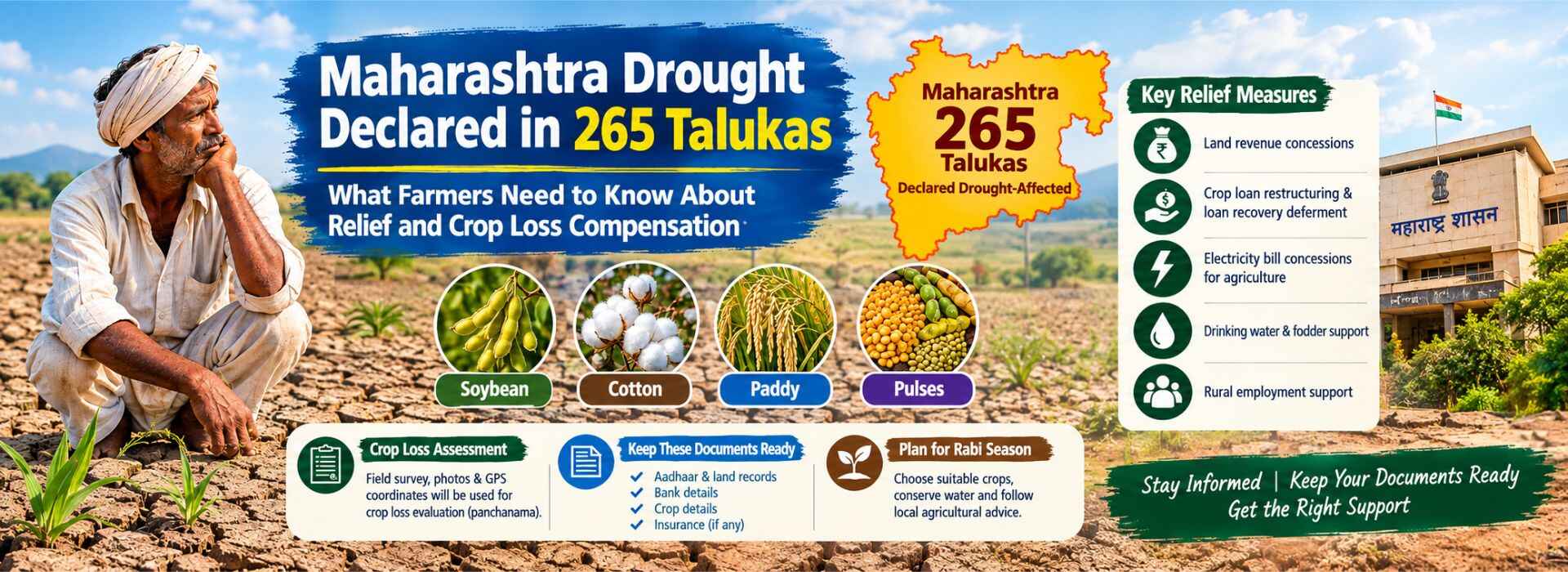
Maharashtra Drought Declared in 265 Talukas: What Farmers Need to Know About Relief and Crop Loss Compensation
October 8, 2026Maharashtra Drought Declared in 265 Talukas: What Farmers
Need to Know About Relief and Crop Loss Compensation
Maharashtra is facing a serious agricultural challenge after
deficient monsoon rainfall and prolonged dry spells affected Kharif crops
across the state. On September 26, 2026, the state government declared 265 out
of 358 talukas drought-affected, covering approximately 74% of Maharashtra. The
declaration triggered crop-damage assessments and a package of relief measures
for affected rural communities.
Akashvani News
For farmers, the key questions are practical: What relief has
been announced? How will crop losses be assessed? What documents should farmers
keep ready? And when will direct compensation be decided?
This article explains the announced measures, the crop-loss
assessment process and the steps farmers can take to stay prepared.
1. Why Has Maharashtra Declared Drought in 265 Talukas?
Insufficient rainfall and extended dry spells during the 2026
Kharif season have reduced soil moisture and increased pressure on agricultural
water supplies. The drought declaration was made under the state's Drought
Management Code after an assessment of rainfall shortages and other drought
indicators.
The Times of India
The situation is affecting different farming regions and
crops, including soybean, cotton, maize and paddy. In parts of Marathwada and
Vidarbha, farmers have also reported crop losses, declining water availability
and concerns about fodder supplies.
Akashvani News
The impact varies by village, crop, soil type and rainfall
pattern. Farmers should therefore check their own taluka's official status and
follow instructions from local revenue and agriculture offices.
2. What Relief Measures Has the Maharashtra Government
Announced?
The drought declaration provides for a set of immediate
concessions and essential support measures. These are intended to reduce the
financial pressure on farming households while authorities assess the extent of
crop damage.
Akashvani News
The main measures include:
Land revenue concessions
Eligible farmers in notified drought-affected areas may
receive the land revenue concessions specified under the government order.
Crop loan restructuring
Eligible agricultural loans may be restructured according to
applicable government and banking instructions.
Deferment of agricultural loan recovery
Recovery of eligible agricultural loans is to be deferred
under the announced measures. Farmers should confirm the procedure with their
lending bank.
Agricultural electricity bill concessions
Electricity-related relief has been announced for
agricultural pumps, along with measures to maintain supply in villages facing
water shortages.
Drinking water and fodder support
Authorities have been directed to arrange water tankers where
necessary and make provisions for drinking water and livestock fodder.
Rural employment support
Relaxation of employment-guarantee scheme norms is among the
announced measures, helping facilitate employment in drought-affected areas.
These measures do not mean every farmer automatically
qualifies for every benefit. Eligibility, implementation and documentation
requirements depend on the relevant government orders and local administration.
3. Is Direct Crop Loss Compensation Confirmed?
The amount of direct financial compensation for the 2026
Kharif crop losses had not been finalized in the latest reports available as of
October 8, 2026.
The government has stated that crop-loss assistance will be
decided separately after the prescribed assessments are completed. The
Agriculture Minister has also said the state aims to provide drought relief
before Diwali, while officials have been directed to complete field assessments
promptly. This is a stated target, not a guarantee of a payment date for every
farmer.
Moneycontrol
Farmers should be careful about social media posts claiming
that a fixed amount per hectare has already been approved for everyone.
The amount, eligibility criteria and payment process should
be confirmed through an official Government Resolution (GR) or notification.
4. How Will Crop Loss Assessment (Panchnama) Work?
A panchnama is an official field-level assessment that
records damage and relevant details for consideration under the relief process.
According to reports, district authorities have been
instructed to assess crop damage and document it using photographs and GPS
coordinates. The government will use these assessments to determine the next
steps for crop-loss assistance.
Akashvani News
The process generally involves:
- Field
inspection: Revenue and agriculture officials inspect affected fields and
record crop damage.
- Damage
documentation: The crop, affected area and extent of damage are recorded,
with photographs and location details where required.
- Administrative
verification: Assessment reports are compiled and reviewed at the relevant
taluka and district levels.
- Government
decision: The government issues the applicable order specifying approved
assistance and eligibility.
- Beneficiary
verification and payment: Eligible records are processed under the
applicable procedure, which may include identity verification or e-KYC.
Farmers should not assume that a field visit alone guarantees
compensation. The official assessment, eligibility rules and subsequent
approval remain important.
5. Documents Farmers Should Keep Ready
To avoid delays when authorities request verification,
farmers should keep the following information organized.
Document checklist
0 of 8
Aadhaar card and registered mobile number
Land ownership or land-record documents, such as 7/12 extract
and 8A, as applicable
Bank passbook or account details linked to Aadhaar, where
required
Crop sowing details and the crops grown during Kharif 2026
Farm survey number and affected area details
Crop insurance policy and application/claim details, if
insured
Photographs or other records of crop damage, if available
Previous relief application or panchnama reference, if one
exists
Copy checklist
This is a practical preparation list, not a claim that every
document is mandatory in every case. Confirm the exact requirements with your
Talathi, Gram Sevak, agriculture officer or Tahsil office.
6. What Should Farmers Do If Their Crop Damage Has Not Been
Recorded?
If your field has suffered major losses but the damage
assessment has not taken place, take these steps:
- Contact
your local Talathi or agriculture assistant and request information about
the panchnama schedule.
- Provide
the correct village, survey number, crop name and affected area.
- Ask
whether the assessment has been recorded and whether any reference number
is available.
- Keep
copies of submitted documents and note the date of your request.
- If
the recorded details appear incorrect, approach the Tahsil office or
district administration to ask about the correction or grievance process.
Do not pay an agent who promises guaranteed compensation or
demands money to complete a government panchnama. Maharashtra's published
natural-disaster relief procedure states that the e-KYC process for that relief
scheme is free of charge.
7. What About Crop Insurance?
Drought relief and crop insurance are separate processes. A
drought declaration does not automatically establish that every insured farmer
will receive a claim.
Farmers covered by the applicable crop insurance scheme
should check their policy, notified crop and area, the scheme's current rules,
and any claim-reporting deadlines. Keep the insurance application number,
policy details and records of crop damage available.
For claim-specific guidance, contact the insurer, the
agriculture department or the official crop insurance portal. Do not assume
that a particular deadline or payment amount applies without checking the rules
for your scheme and season.
8. Where Can Farmers Check Official Updates?
Use official channels to verify new orders, eligibility and
payment progress.
Maharashtra Relief and Rehabilitation Department
Government Resolutions, disaster-relief information and
published assistance procedures.
Visit official department website
MahaDBT Farmer Portal
Useful for checking applicable agriculture-scheme information
and relevant application services. It is not a substitute for confirming
drought compensation orders.
Visit MahaDBT Farmer Portal
Local Tahsil Office and District Collector
Best starting points for local panchnama status,
notified-area information, document corrections and grievance escalation.
9. Planning for the Rabi Season After Drought
The drought's effects may continue after the Kharif harvest.
Reduced soil moisture and depleted water sources can make Rabi sowing more
difficult, especially in rainfed areas.
Farmers should:
- Choose
crops and varieties according to local soil moisture and available
irrigation.
- Consider
suitable short-duration or lower-water crops based on local agricultural
advice.
- Conserve
crop residues and rainfall wherever practical.
- Avoid
spending heavily on seed, fertilizer or irrigation without assessing water
availability.
- Check
with the local Krishi Vigyan Kendra (KVK) or agriculture department before
making major changes to the cropping plan.
The right choice will differ between regions and farms. A
recommendation suitable for an irrigated field may not be appropriate for a
rainfed field facing severe water shortage.
Conclusion
Maharashtra's declaration of drought in 265 talukas is an
important step toward organizing relief after the weak 2026 monsoon. Announced
measures include land revenue concessions, crop loan restructuring, deferment
of eligible agricultural loan recovery, electricity-related relief and drinking
water and fodder arrangements.
Akashvani News
However, direct crop-loss compensation depends on the
assessment process and the applicable government order. Farmers should ensure
that their crop damage is recorded accurately, keep their documents ready,
follow official updates and avoid relying on unverified compensation
announcements.
The most important action now is to contact the local revenue
or agriculture office and confirm the status of the panchnama and the relief
process for your village.

Guest reviews
No reviews found for this Blog