

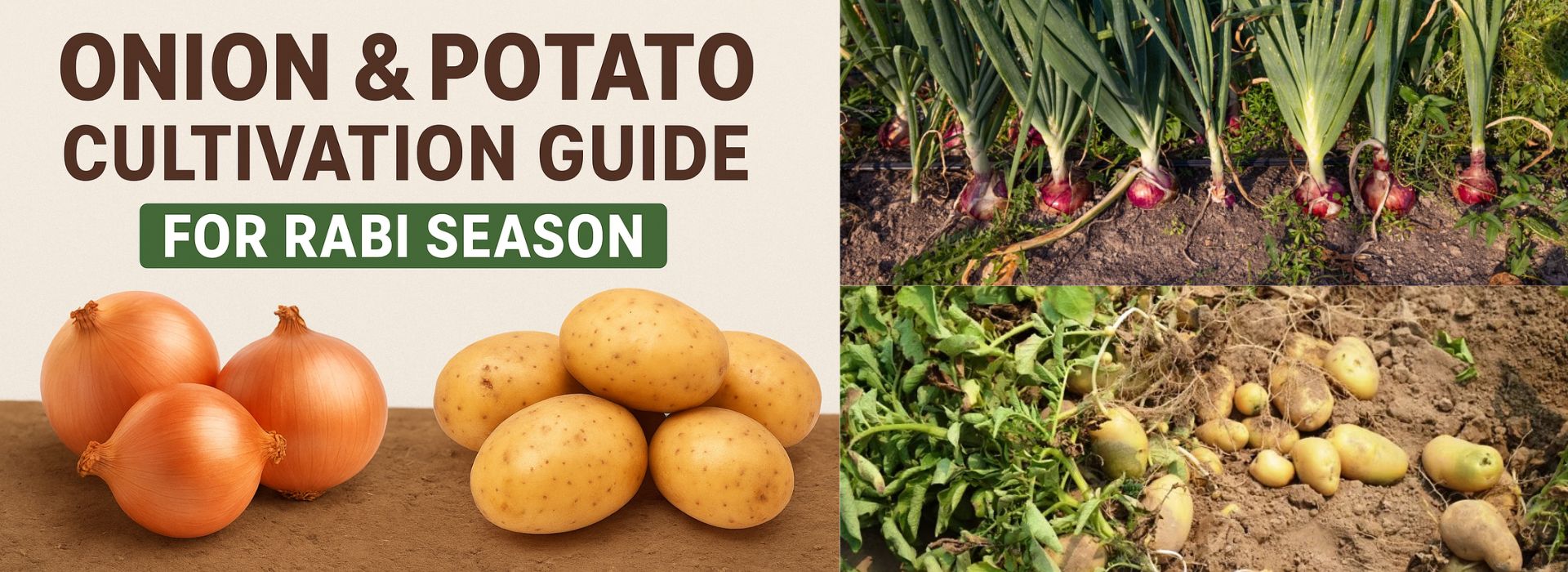
Onion & Potato Cultivation Guide for Rabi Season
December 3, 2025🧅🥔 Onion
& Potato Cultivation Guide for Rabi Season
A Complete Farming Guide to Maximize
Yield & Profit
Introduction
Onion and potato are two of the most
essential Rabi crops in India, forming a major part of household consumption
and market demand. With changing climate patterns, water scarcity, and rising
input costs, farmers need updated and practical knowledge to cultivate these
crops efficiently.
This guide covers soil preparation, seed selection, irrigation, pest
control, and harvesting for both onion and potato specifically for the Rabi
season.
🧅 ONION
CULTIVATION GUIDE (RABI SEASON)
1. Ideal Climate & Temperature
Onions thrive in cool weather for
vegetative growth and warm, dry weather for bulb formation.
- Optimal temperature: 13–24°C
- Sensitive to frost, so early protection
is needed in northern states.
2. Soil Requirements
- Light to medium loamy soils with
good drainage
- pH: 6.0–7.5
- Avoid waterlogging as it leads to bulb
rot.
3. Land Preparation
- Plough 2–3 times
- Add well-decomposed FYM (15–20 tons/acre)
- Create raised beds for better bulb
development
4. Nursery Preparation & Seedlings
- Use high-quality seeds (1–1.5 kg/acre)
- Nursery duration: 45–55 days
- Apply compost + neem cake before
transplanting
- Transplant spacing:
- Row spacing: 15
cm
- Plant spacing: 10
cm.
5. Irrigation Management
- First irrigation immediately after
transplanting
- Then irrigate at 7–10 day intervals
- Reduce watering during bulb maturing to
avoid fungal diseases
6. Fertilizer Schedule
- FYM: 15–20 tons/acre
- NPK (Recommended): 40:20:20 kg/acre
- Apply nitrogen in 3 split doses
7. Pest & Disease Management
Common issues:
- Thrips
- Purple blotch
- Cutworms
- Stemphylium blight
Control methods:
- Use neem oil sprays
- Maintain proper spacing
- Apply approved pesticides only when
necessary
8. Harvesting & Storage
- Harvest when leaves start drooping and
necks shrink
- Dry bulbs in shade for 3–5 days
- Store at cool, dry, well-ventilated
places
🥔 POTATO
CULTIVATION GUIDE (RABI SEASON)
1. Ideal Climate
Potato is a cool-season crop.
- Best temperature: 15–20°C
- Frost-sensitive, so choose the right
sowing time
2. Soil Requirements
- Loose, well-drained sandy loam or loamy
soil
- pH: 5.5–6.5
- Good organic matter supports tuber
formation
3. Land Preparation
- Deep ploughing to break soil compaction
- Add FYM 20–25 tons/acre
- Create ridges and furrows as potatoes
grow underground
4. Seed Selection & Sowing
- Use certified disease-free seed tubers
- Seed rate: 8–10 quintals/acre
- Cut tubers must have at least one
healthy eye
Spacing
- Row spacing: 60 cm
- Plant spacing: 20–25 cm
5. Irrigation Management
- First irrigation: immediately after
planting
- Subsequent irrigation: every 6–8 days
- Avoid overwatering → leads to rot and
scab
6. Fertilizer Schedule
- FYM: 20–25 tons
- NPK recommended: 40:20:20 kg/acre
- Potassium enhances tuber size and quality
- More nitrogen = more leaves, fewer tubers
→ avoid excess
7. Pest & Disease Management
Common issues:
- Late blight
- Early blight
- Aphids
- Potato tuber moth
Solutions:
- Use disease-resistant varieties
- Follow proper crop rotation
- Spray copper-based fungicides when
necessary
- Harvest on time to avoid tuber moth
infestation
8. Harvesting & Storage
- Plants are ready when foliage turns
yellow and dries
- Keep harvested potatoes in shade for
curing
- Maintain storage temperature at 4–7°C
🌿 BONUS
TIPS FOR BOTH CROPS
- Practice mulching to retain soil
moisture
- Use drip irrigation for better
water use efficiency
- Rotate onion and potato with leguminous
crops next season
- Adopt biofertilizers to cut down chemical
usage
🌾
Conclusion
Onion and potato are vital cash crops
for Rabi season farmers. With proper land preparation, improved seed varieties,
efficient irrigation, and smart pest control methods, farmers can significantly
increase yield and profit.
Adopting modern techniques and sustainable practices will not only lower
production costs but also improve soil health and long-term farm productivity.

Guest reviews
No reviews found for this Blog