

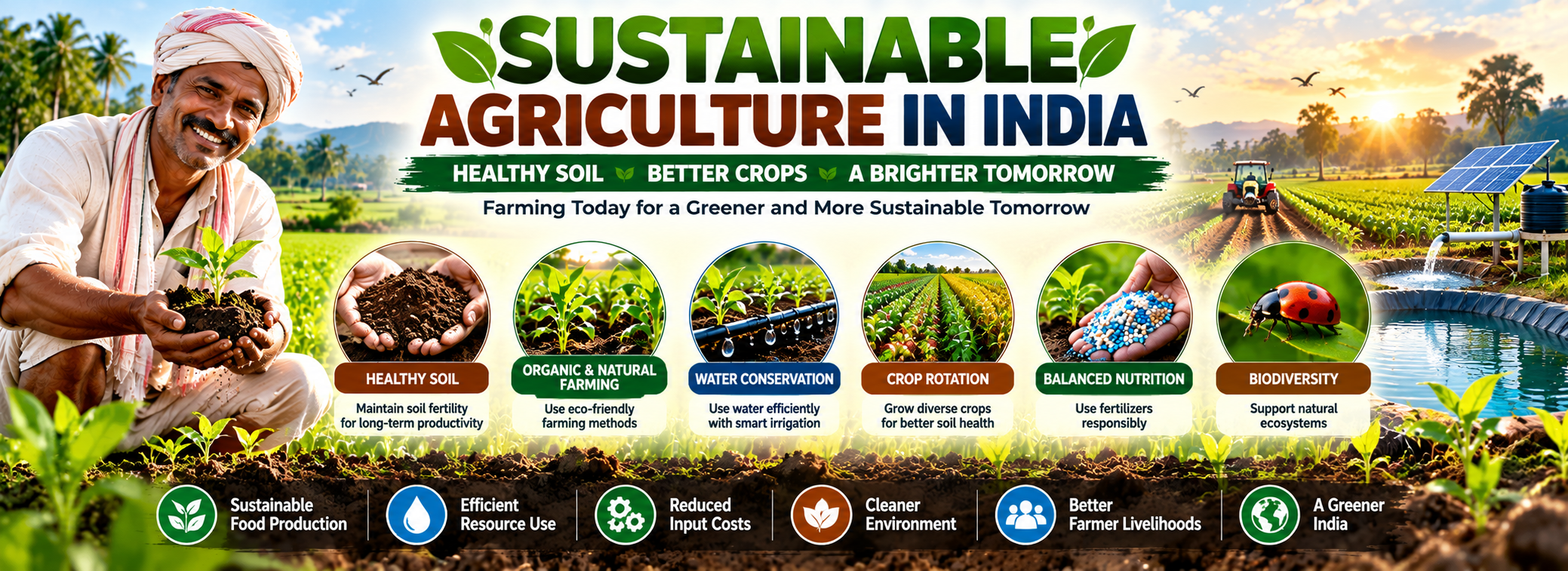
Sustainable Agriculture in India
October 31, 2026Discover sustainable agriculture practices in India, including organic farming, soil health management, water conservation, crop rotation, and balanced fertilizer use.
1. What Is Sustainable Agriculture?
Sustainable agriculture is a farming approach that balances crop production, environmental protection, and economic viability.
It focuses on maintaining soil health, conserving water, managing nutrients efficiently, and reducing unnecessary chemical and resource use.
The main objectives include:
Maintaining long-term soil fertility.
Using water and fertilizers efficiently.
Protecting biodiversity and natural resources.
Reducing avoidable farming expenses.
Supporting stable agricultural production.
2. Organic Farming and Natural Farming
Organic farming uses approved organic inputs and follows specific production standards that restrict or prohibit many synthetic fertilizers and pesticides.
Natural farming approaches emphasize ecological processes, locally available resources, and reduced dependence on external inputs.
Farmers can explore practices such as composting, farmyard manure application, mulching, and biological pest management.
However, organic and natural farming methods should be adopted according to crop requirements, local conditions, and applicable certification standards.
3. Improve Soil Health and Fertility
Healthy soil is essential for sustainable crop production. Continuous cultivation and unbalanced fertilizer application can contribute to nutrient depletion and soil degradation.
Farmers can improve soil health through:
Regular soil testing to understand nutrient availability and soil pH.
Adding suitable organic matter such as well-decomposed compost.
Practising crop rotation with suitable legume crops.
Maintaining soil cover to reduce erosion.
Applying fertilizers according to soil test recommendations.
Balanced fertilizer management helps crops receive essential nutrients without unnecessary applications.
4. Water Conservation and Smart Irrigation
Water conservation is a major part of sustainable agriculture, especially in drought-prone regions of India.
Drip irrigation delivers water near plant roots and can improve water-use efficiency when properly designed and maintained. Sprinkler irrigation is another suitable option for certain crops and field conditions.
Farmers can also consider rainwater harvesting, farm ponds, mulching, and proper drainage systems to manage available water resources.
5. Crop Rotation and Biodiversity
Growing the same crop repeatedly can increase certain pest and disease problems and contribute to nutrient imbalances.
Crop rotation involves growing different crops in sequence. Including suitable legumes such as chickpea, green gram, and pigeon pea can contribute nitrogen through biological nitrogen fixation.
Growing different crops and maintaining suitable field vegetation can also support biodiversity and improve overall farm resilience.
6. Balanced Fertilizer and Integrated Nutrient Management
Plants need essential nutrients such as nitrogen, phosphorus, and potassium for healthy growth.
Integrated nutrient management combines suitable organic sources, mineral fertilizers, and biological inputs where appropriate.
Farmers should:
Select fertilizers based on crop requirements.
Follow soil testing recommendations.
Apply nutrients at suitable growth stages.
Avoid excessive fertilizer application.
Follow product labels and expert guidance.
Using the right nutrients in appropriate quantities can support crop growth and reduce unnecessary input costs.
Visit Krishibazaar.in for agricultural products, fertilizer information, crop nutrition guidance, and useful farming updates.
Disclaimer: Farming practices and input requirements vary by region and crop. Consult qualified agricultural experts for recommendations suitable for local soil and climate conditions.



Guest reviews
No reviews found for this Blog