

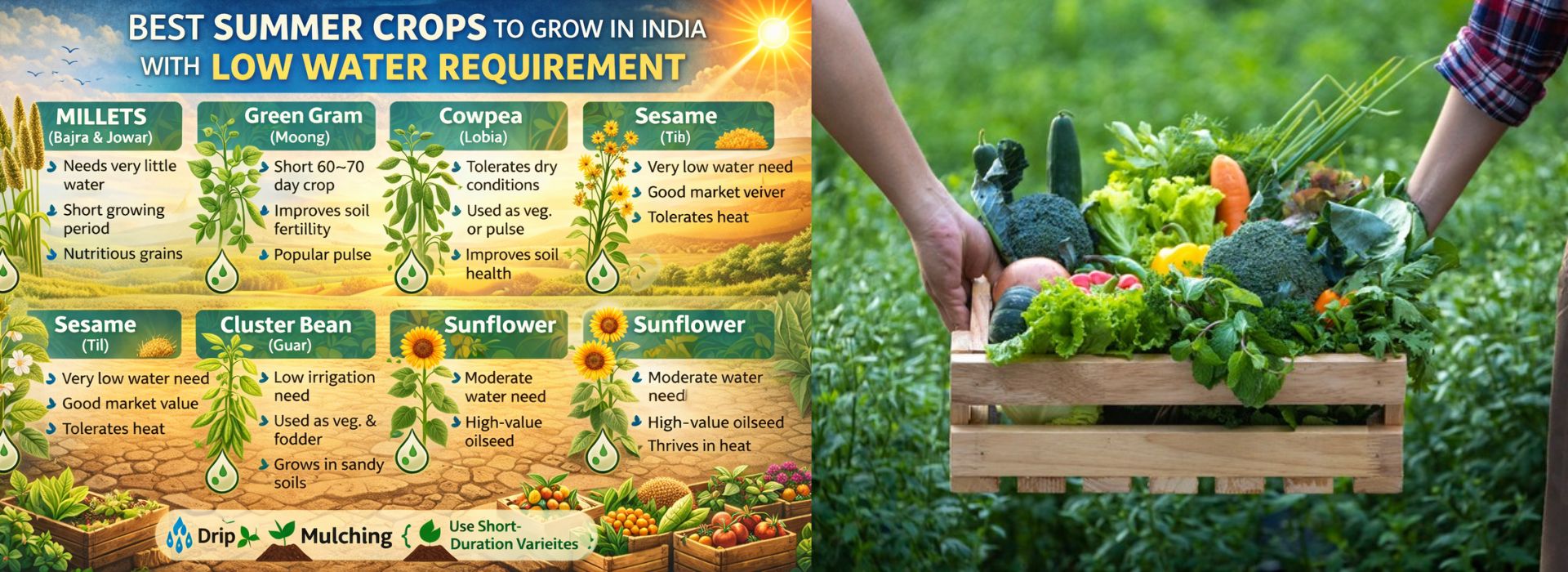
Best Summer Crops to Grow in India with Low Water Requirement
March 6, 2026Best Summer Crops to Grow in India with Low Water Requirement
Summer farming in India can be challenging due to high
temperatures, water scarcity, and increased irrigation costs. However,
several crops can thrive even with limited water availability. Choosing the
right crops helps farmers reduce irrigation needs, save costs, and maintain
good yields.
Low-water crops are especially useful for farmers in drought-prone regions or areas with limited irrigation facilities.
Why Grow Low-Water Crops in Summer?
Growing crops that require less water provides several
benefits:
- Reduces
irrigation expenses
- Suitable
for dry and semi-arid regions
- Helps
conserve groundwater
- Minimizes
crop stress during heat waves
- Improves
farm sustainability
These crops are also ideal for farmers practicing climate-resilient agriculture.
1. Millets (Bajra and Jowar)
Millets are among the most drought-tolerant crops in India.
Key advantages:
- Very
low water requirement
- Short
growing period
- Highly
nutritious grain
- Suitable
for poor soils
Millets are widely grown in states like Rajasthan, Maharashtra, and Karnataka.
2. Green Gram (Moong)
Moong is a popular summer pulse crop that requires minimal
irrigation.
Benefits:
- Short
crop duration (60–70 days)
- Improves
soil fertility through nitrogen fixation
- Good
market demand
Moong is commonly grown after wheat harvest during the summer season.
3. Cowpea (Lobia)
Cowpea is highly tolerant to heat and drought conditions.
Advantages:
- Grows
well with limited irrigation
- Can
be used as vegetable, pulse, or fodder
- Improves
soil health
It is a great option for farmers practicing intercropping or mixed farming.
4. Sesame (Til)
Sesame is a traditional oilseed crop suitable for dry
climates.
Benefits:
- Requires
very little water
- Good
market value
- Tolerant
to high temperatures
Sesame cultivation is common in Gujarat, Uttar Pradesh, and Madhya Pradesh.
5. Cluster Bean (Guar)
Cluster bean is a hardy crop that grows well in dry
conditions.
Advantages:
- Low
irrigation requirement
- Used
for vegetable, fodder, and industrial gum production
- Suitable
for sandy soils
It is widely grown in Rajasthan and Haryana.
6. Sunflower
Sunflower is another crop that can tolerate dry conditions.
Benefits:
- Moderate
water requirement
- High-value
oilseed crop
- Adaptable
to different soil types
It can be grown during summer with limited irrigation.
Tips for Successful Low-Water Summer Farming
Use Drip Irrigation
Drip systems deliver water directly to plant roots, reducing
water wastage.
Apply Mulching
Mulching helps conserve soil moisture and reduce evaporation.
Choose Short-Duration Varieties
Short-duration crops require fewer irrigations.
Improve Soil Organic Matter
Adding compost improves soil moisture retention.
Plan Early Morning Irrigation
Watering during cooler hours reduces evaporation loss.
Final Thoughts
Summer farming does not always require large amounts of
water. By selecting drought-tolerant crops such as millets, moong, sesame,
and cowpea, farmers can maintain productivity even during water scarcity.
Combining the right crop choices with efficient irrigation
techniques and soil management can help farmers achieve sustainable and
profitable summer agriculture.
Low-water crops are a smart solution for climate-resilient
farming in India.
Keywords:
summer crops India, low water crops, drought resistant crops, summer farming
India, water saving agriculture
At krishibazaar.in, you
can find and buy various agricultural products. For agricultural guidance on
selecting the most suitable products for your crops, please contact or WhatsApp
at +917887880887.

Guest reviews
No reviews found for this Blog