

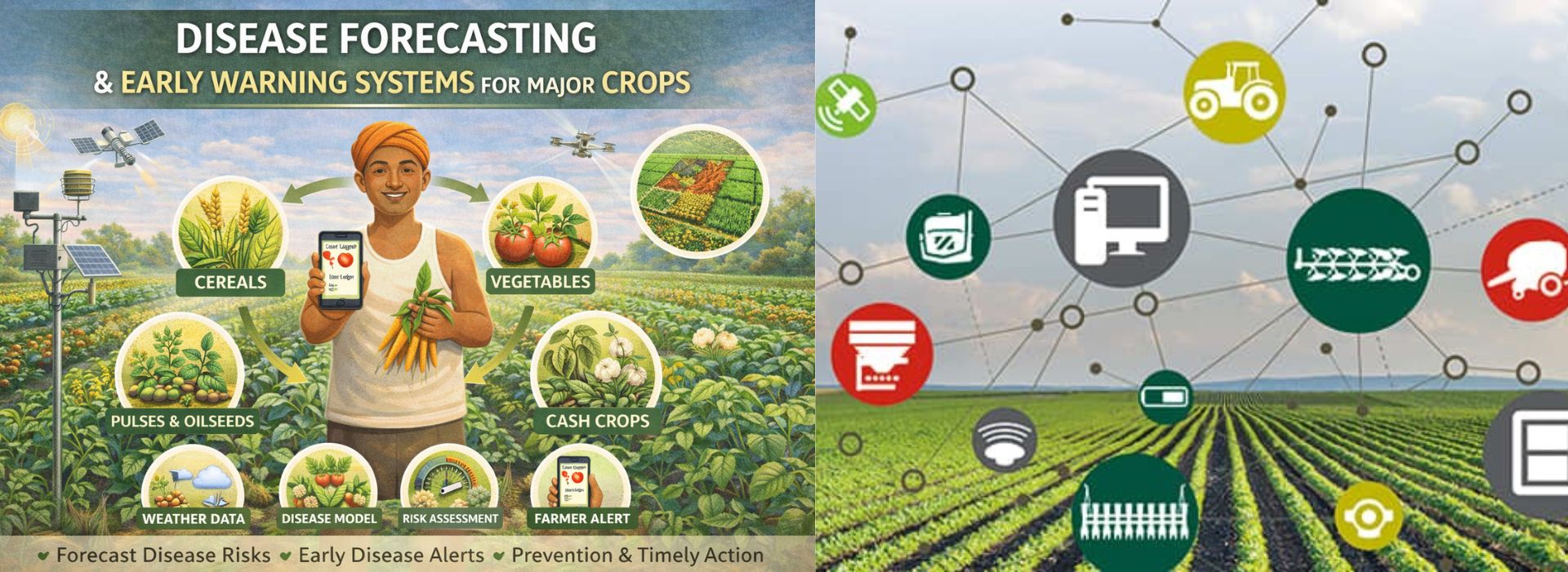
Disease Forecasting and Early Warning Systems for Major Crops
February 6, 2026Disease Forecasting and Early
Warning Systems for Major Crops
Crop diseases are one of the
biggest threats to agricultural productivity, often causing heavy yield losses
and increased input costs. Traditionally, farmers respond to diseases after
symptoms appear, when damage is already done.
Disease Forecasting and Early
Warning Systems (DFEWS) are changing this approach by helping farmers predict
disease outbreaks in advance and take timely preventive action.
🌾 What Is Disease
Forecasting in Agriculture?
Disease forecasting uses weather
data, crop stage information, pest history, and scientific models to
predict the likelihood of disease occurrence in crops.
Early warning systems then alert
farmers through advisories, mobile apps, SMS, or extension
services—allowing them to act before the disease spreads.
🌦 Why Weather Plays a
Key Role in Disease Outbreaks
Most crop diseases are highly
influenced by:
- Temperature
- Humidity
- Rainfall
- Wind and leaf wetness
For example:
- High humidity + moderate temperature →
Fungal diseases
- Warm and wet conditions → Bacterial
infections
- Sudden weather changes → Viral disease
spread
Disease forecasting systems
analyze these factors to estimate disease risk.
🚜 Major Crops Benefiting
from Disease Forecasting
🌾 Cereals
- Rice: Blast, bacterial leaf blight
- Wheat: Rusts, leaf blight
- Maize: Leaf blight, downy mildew
🌱 Pulses & Oilseeds
- Soybean: Rust, yellow mosaic virus
- Chickpea: Wilt, Ascochyta blight
- Groundnut: Leaf spot, rust
🍅 Vegetables
- Tomato: Late blight, leaf curl virus
- Potato: Late blight
- Chilli: Anthracnose, leaf curl
🌿 Cash Crops
- Cotton: Boll rot, bacterial blight
- Sugarcane: Red rot, smut
📡 How Early Warning
Systems Work
- Data Collection
- Weather stations
- Satellite imagery
- Field observations
- Historical disease data
- Disease Modeling
- Predicts disease probability based on conditions
- Risk Assessment
- Low, medium, or high disease risk alerts
- Farmer Advisory
- Preventive measures
- Spray schedules
- Cultural practices
📱 Technology Used in
Disease Forecasting
- Automated weather stations (AWS)
- Satellite and drone imagery
- Mobile apps and SMS alerts
- AI-based predictive models
- Decision support systems (DSS)
These tools make advanced science
accessible even to small farmers.
🌿 Benefits of Disease
Forecasting for Farmers
✅ Reduced Crop Losses
Early action prevents disease
spread and minimizes yield loss.
✅ Lower Pesticide Use
Targeted sprays reduce
unnecessary chemical applications.
✅ Cost Savings
Less spending on repeated sprays
and curative treatments.
✅ Better Crop Quality
Healthy crops lead to higher
market value.
✅ Environment Protection
Reduced chemical use supports
sustainable farming.
🌍 Disease Forecasting in
Indian Agriculture
In India, disease forecasting
systems are being promoted through:
- Agrometeorological Advisory Services (AAS)
- State agriculture departments
- ICAR and Krishi Vigyan Kendras (KVKs)
- Private agri-tech platforms
Farmers receive location-specific
advisories based on local weather and crop stage.
🧑🌾 How Farmers
Can Use Early Warning Systems Effectively
- Register for agromet or advisory services
- Monitor local weather updates
- Follow preventive spray schedules
- Combine forecasts with field scouting
- Use resistant varieties when advised
Disease forecasting works best
when combined with Integrated Pest and Disease Management (IPDM).
🌟 Challenges and Future
Scope
Challenges:
- Limited weather station coverage in some areas
- Low awareness among farmers
- Need for local-level accuracy
Future Opportunities:
- AI-based real-time alerts
- Village-level disease prediction
- Integration with smart farming tools
✅ Conclusion
Disease forecasting and early
warning systems are transforming crop protection from reactive to proactive.
By predicting disease risks in advance, farmers can protect their crops, reduce
costs, and improve productivity.
As climate variability increases,
these systems will play a critical role in sustainable and profitable
farming, especially for major crops.
Early warning means early
action—and healthier harvests.
🔖 Keywords:
Disease forecasting, early warning systems, crop disease management, smart
farming, Indian agriculture, pest and disease prediction
At krishibazaar.in, you
can find and buy various agricultural products. For agricultural guidance on
selecting the most suitable products for your crops, please contact or WhatsApp
at +917887880887.

Guest reviews
No reviews found for this Blog