

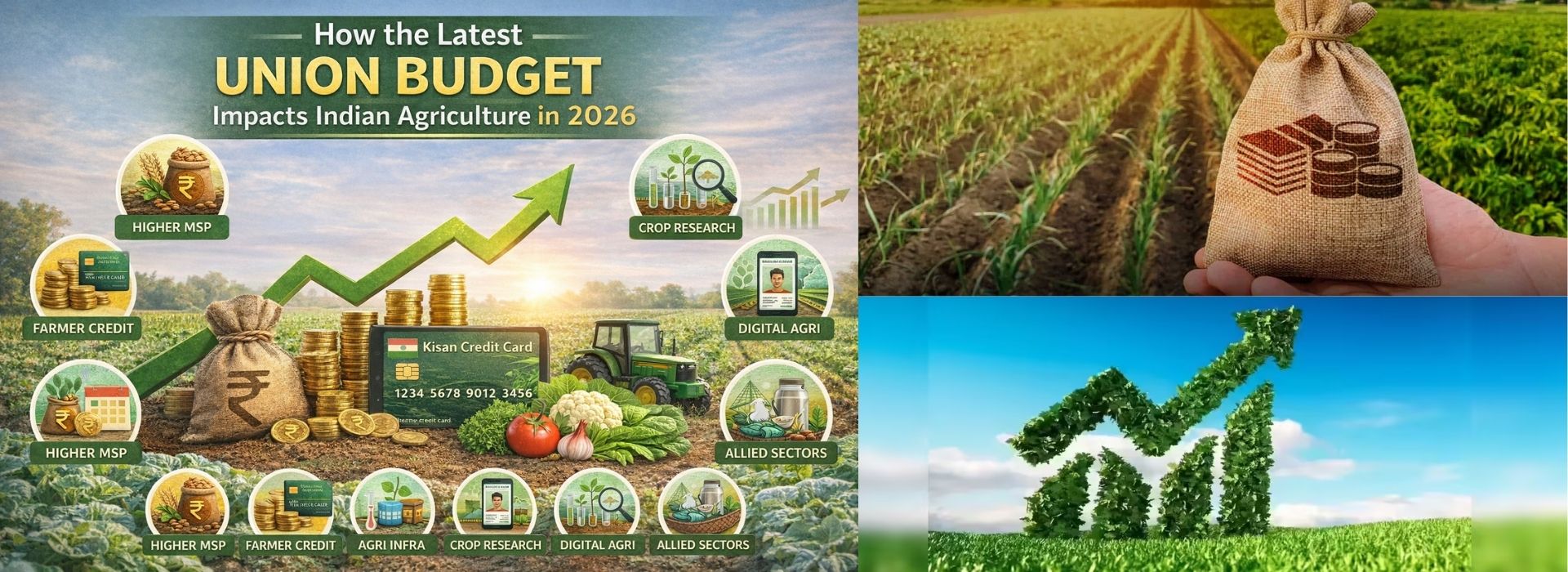
How the Latest Union Budget Impacts Indian Agriculture in 2026
January 6, 2026How the Latest Union Budget Impacts Indian Agriculture in
2026
The Union Budget is one of
the most important annual policy events for Indian agriculture, directly
shaping farmer incomes, market stability, rural employment, and long-term
growth prospects. The 2026 budget cycle continues several key reforms
and investments begun in previous years and reflects growing emphasis on structural
change, sustainability, digital agri-transformation, and productivity
enhancement. The
Financial Express
In this blog, we break down the major
budget themes and their real-world impact on Indian farmers in 2026.
🌾 1. Higher Minimum
Support Prices (MSP) for Farmer Protection
MSP increases for major Rabi
crops were approved for the 2026-27 marketing season, including wheat,
gram, barley, safflower and lentil. These hikes—such as a ₹160 increase for
wheat and ₹600 for safflower—are designed to ensure remunerative returns
over production costs. @mathrubhumi
Impact:
✅
Encourages farmers to continue crop cultivation without fear of price collapses
✅
Strengthens rural economies by stabilizing income
💡
Helps align market prices with inflation and rising input costs
💰 2. Credit Access and
Affordable Loans for Farmers
The budget framework proposes
wider access to credit through Kisan Credit Cards (KCC) and related
schemes:
- Higher credit limits under Modified Interest
Subvention to support farming and allied activities
- Collateral-free loan expansion to empower
small and marginal farmers
- Continuation of subsidized interest rates
encouraging prompt repayment
This improves liquidity for
inputs like seeds, fertilizer and machinery and reduces dependence on informal
credit. Department of
Financial Services
🥦 3. Infrastructure, Cold
Chains & Post-Harvest Support
The government is set to invest
heavily in agricultural infrastructure, including:
- Cold storage and logistic networks to reduce
post-harvest wastage
- Grain handling, warehousing and food parks
- Expansion of the Agriculture Infrastructure Fund
These investments are expected to
cut post-harvest losses—currently a major drain on farmer profits—and link
production to markets more efficiently. RP Realty Plus
🌍 4. Rural Prosperity and
Resilience Programme
The budget outlines a multi-sectoral
rural programme with partners across states. Its goal is to:
✔ Provide skilling,
technology and investment support
✔ Address underemployment in rural areas
✔ Boost incomes through value-added activities like
food processing and allied businesses
This shift puts rural economies
on a broader growth path beyond pure farming income, especially for women,
youth and landless families. The
Times of India
📈 5. Agriculture
Research, High-Yield Seeds & Crop Innovations
The budget reinforces investment
in:
- Agricultural research and extension services
- Development of high-yielding, climate-resilient
crop varieties
- Expanded seed quality regulations (including
proposed seed-law reforms) to combat substandard inputs in the market. Business Standard
Recently, the government
announced 184 new crop varieties of cereals, Bt cotton, pulses and
oilseeds to enhance climate resilience and productivity in 2026. The Times of India
🌐 6. Digital Agriculture
& Farmer Services
Emerging proposals under
discussion—such as a Digital Farmer Card—aim to digitize land records,
crop details, insurance status and subsidy access. This would streamline
service delivery and reduce bureaucratic delays for farmers. CMV360
Potential Benefits:
✨
Fast tracking of subsidy claims and crop insurance
✨
Real-time weather and advisory alerts
✨
Better integration with agri-credit and extension services
🌱 7. Boosting Allied
Sectors & Livelihoods
Union support for allied sectors
such as fisheries, animal husbandry, dairying and horticulture has
increased. In the 2025-26 fiscal year, these sectors received a 37% jump in
budgetary allocation, reflecting a broader agenda to diversify rural income
beyond staple crops. The
Times of India
Moreover, schemes like G RAM G
aim to ensure labor availability during peak sowing and harvesting seasons,
reducing dependency on migrant workforce and improving rural employment
stability. The Times of
India
🧠 8. Market & Export
Considerations
Ahead of the 2026 budget
announcement, farming federations—especially in sectors like rice—have demanded
targeted support to maintain global competitiveness, export sustainability
and relief from rising operational costs. This reflects the dual focus on
domestic stability and export expansion. The Economic Times
📊 Overall Impact on
Indian Agriculture in 2026
Positive Outcomes
✅ Stronger income protection via
MSP and procurement support
✅
Better infrastructure for storage, market linkages and cold chains
✅
Wider credit access improves investment capacity
✅
Rural and allied sector focus expands livelihood opportunities
✅
Advancements in crop research and digital agriculture boost productivity
Challenges and Ongoing Areas
🔹 Balanced implementation
of schemes at state and local levels
🔹
Ensuring timely infrastructure deployment
🔹
Addressing climate and groundwater stress through deeper investments
🔹
Faster roll-out of digital services for small farmers
📝 Conclusion
The latest Union Budget continues
to treat agriculture as a central pillar of India’s economy. By expanding
credit, supporting MSPs, strengthening infrastructure, and promoting rural
resilience and innovations, the budget aims for sustainable growth and improved
farmer incomes in 2026 and beyond.
As policies roll out and
governance deepens, farmers stand to benefit most from better market access,
financial inclusion, and modern agricultural technologies—creating a more resilient
and profitable agricultural ecosystem.
At krishibazaar.in, you
can find and buy various agricultural products. For agricultural guidance on
selecting the most suitable products for your crops, please contact or WhatsApp
at +917887880887.



Guest reviews
No reviews found for this Blog