

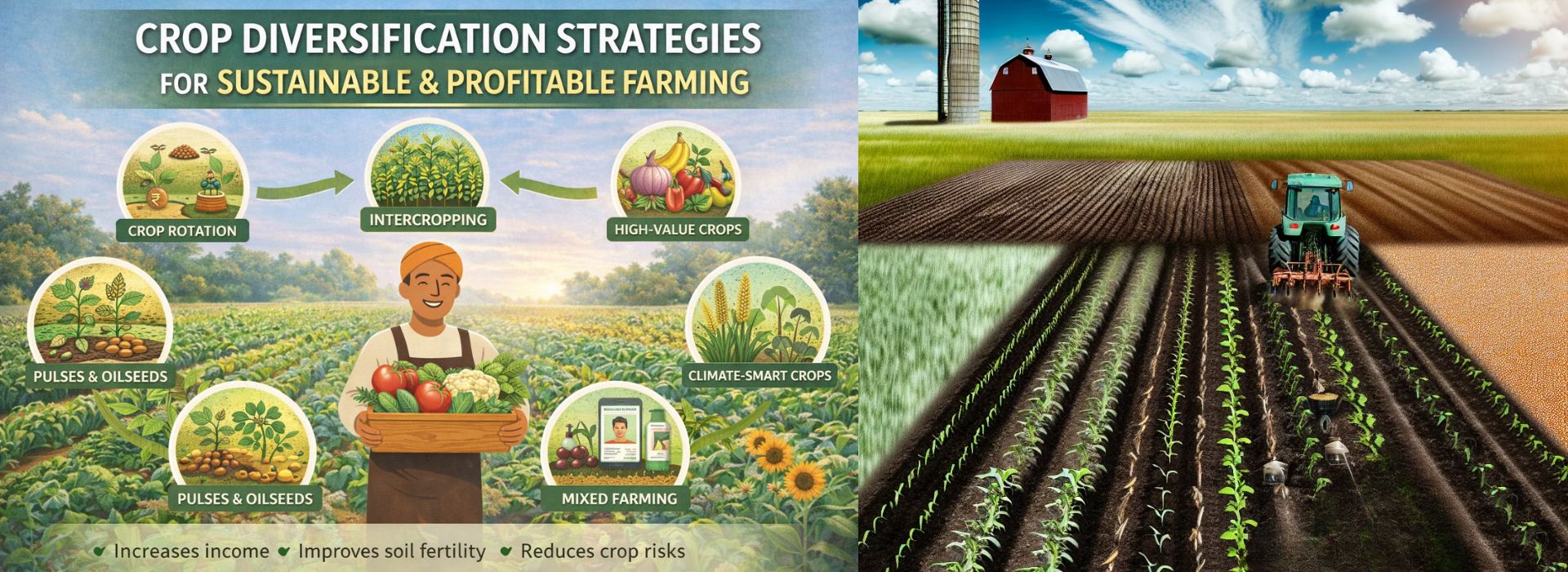
Crop Diversification Strategies for Sustainable and Profitable Farming
January 13, 2026Crop
Diversification Strategies for Sustainable and Profitable Farming
Modern
agriculture faces many challenges—declining soil fertility, climate
uncertainty, rising input costs, and fluctuating market prices. Relying on a
single crop year after year increases risk and reduces long-term profitability.
Crop
diversification is a proven
strategy that helps farmers improve income stability, soil health, and
sustainability. By growing a variety of crops instead of monoculture,
farmers can reduce risks and build resilient farming systems.
🌱
What Is Crop Diversification?
Crop
diversification means growing different crops on the same farm—either in
sequence, rotation, or combination—rather than depending on a single crop.
Examples
include:
- Growing
cereals with pulses
- Rotating
vegetables with oilseeds
- Intercropping
cash crops with legumes
This
approach balances economic returns and ecological health.
🌾
Why Crop Diversification Is Important
✅ Key
Benefits
- Reduces risk
from crop failure
- Improves
soil fertility naturally
- Controls
pests and diseases
- Ensures
regular income throughout the year
- Better use
of land, water, and nutrients
Diversification
makes farming more resilient to climate change and market fluctuations.
🌿
1. Crop Rotation for Soil Health & Yield Stability
Crop
rotation involves growing different crops on the same land in a planned
sequence.
🔄
Best Rotation Examples:
- Rice → Pulse
→ Oilseed
- Maize →
Legume → Vegetable
- Cotton →
Wheat → Green manure
🌱
Benefits:
- Breaks pest
and disease cycles
- Improves
soil structure
- Enhances
nutrient availability
- Reduces
fertilizer requirement
Legume
crops like chickpea, lentil, soybean, and green gram fix atmospheric
nitrogen and enrich soil naturally.
🌽
2. Intercropping for Higher Income per Acre
Intercropping
means growing two or more crops simultaneously in the same field.
🌾
Popular Intercropping Systems:
- Maize +
Cowpea
- Cotton +
Black gram
- Sugarcane +
Vegetables
- Pigeon pea +
Groundnut
💰
Advantages:
- Efficient
use of space and sunlight
- Reduced weed
growth
- Additional
income from secondary crop
- Lower pest
infestation
Intercropping
increases total farm productivity without increasing land size.
🥕
3. Diversification into High-Value Crops
Switching
part of land to high-value crops increases profitability.
🌱
Examples:
- Vegetables
(tomato, onion, chilli)
- Fruits
(banana, papaya, pomegranate)
- Medicinal
& aromatic plants (tulsi, aloe vera, lemongrass)
- Spices
(turmeric, ginger, cumin)
These
crops offer better market prices and export opportunities.
🌿
4. Integrating Pulses and Oilseeds
Adding
pulses and oilseeds improves soil fertility and income.
Benefits:
- Pulses
improve nitrogen content
- Oilseeds
improve crop diversity
- Lower water
requirement
- Strong
government support through MSP and schemes
Examples:
soybean, mustard, sunflower, groundnut.
🌾
5. Mixed Farming & Allied Activities
Crop
diversification can be combined with allied farming activities.
🐄
Allied Options:
- Dairy
farming
- Poultry
- Fisheries
- Beekeeping
- Mushroom
cultivation
These
activities provide regular income, reduce dependency on crops alone, and
improve farm sustainability.
🌦
6. Climate-Smart Crop Diversification
Diversification
helps farmers cope with climate risks.
Climate-Resilient
Strategies:
- Drought-tolerant
crops (millets, pulses)
- Short-duration
varieties
- Multiple
seasonal crops (Kharif + Rabi + Summer)
Millets
like jowar, bajra, and ragi are gaining popularity due to their
resilience and nutritional value.
💧
7. Efficient Resource Utilization
Different
crops have different:
- Water
requirements
- Nutrient
needs
- Growth
periods
Diversification
ensures better utilization of soil moisture, fertilizers, and irrigation,
reducing wastage and cost.
🌟
Tips for Successful Crop Diversification
- Choose crops
based on soil type and climate
- Study local
market demand before selection
- Start small
and expand gradually
- Use
certified seeds and improved varieties
- Adopt soil
testing and balanced nutrition
- Seek
guidance from agriculture experts or extension services
✅ Conclusion
Crop
diversification is a powerful strategy for sustainable and profitable
farming. It protects farmers from crop failure, improves soil health, and
ensures stable income throughout the year.
By
adopting smart diversification strategies—crop rotation, intercropping,
high-value crops, and allied activities—farmers can build a resilient,
profitable, and future-ready agricultural system.
Sustainable
farming is not about growing more of one crop—it’s about growing smarter.
At krishibazaar.in, you
can find and buy various agricultural products. For agricultural guidance on
selecting the most suitable products for your crops, please contact or WhatsApp
at +917887880887.
🔖
Tags:
#CropDiversification #SustainableFarming #ProfitableAgriculture #SoilHealth
#IndianAgriculture

Guest reviews
No reviews found for this Blog