

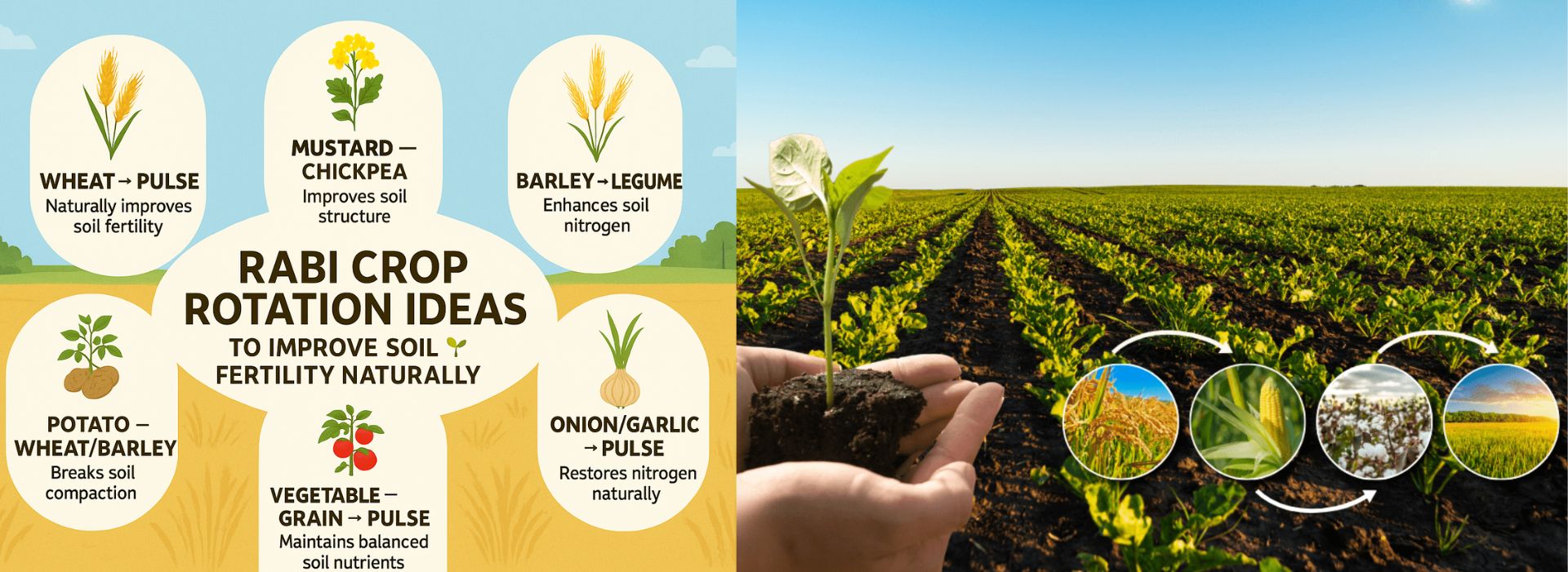
Rabi Crop Rotation Ideas to Improve Soil Fertility Naturally
November 21, 2025🌾 Rabi Crop Rotation
Ideas to Improve Soil Fertility Naturally
Introduction
Rabi season plays a crucial role
in Indian agriculture, with crops like wheat, mustard, gram, and barley forming
the backbone of winter farming. But continuous cultivation of the same crop on
the same land gradually depletes soil nutrients, reduces microbial
activity, and increases pest pressure.
A simple, cost-effective, and sustainable solution to this problem is crop
rotation — the planned sequence of different crops across seasons to
naturally improve soil fertility and maintain farm productivity.
🌱 What Is Crop Rotation
and Why It Matters in Rabi Season?
Crop rotation involves growing
different types of crops on the same field in a systematic order after each
season.
For Rabi, this means choosing nutrient-restoring crops following
nutrient-consuming Kharif crops, to bring balance back to the soil.
Benefits:
- ✔ Naturally replenishes
soil nutrients
- ✔ Reduces pest and disease
cycles
- ✔ Enhances soil structure
and organic matter
- ✔ Improves water retention
- ✔ Supports long-term crop
health and higher yields
🌾 Best Rabi Crop Rotation
Ideas for Indian Farms
1. Wheat → Pulse Rotation
(Gram/Pea/Lentil)
This is one of the most effective
soil-restoring rotations.
Why it works:
- Wheat extracts high amounts of nitrogen.
- Pulses (gram, pea, masoor) fix atmospheric
nitrogen back into the soil through root nodules.
- This rotation naturally improves soil fertility
without heavy fertilizer use.
Ideal For:
North Indian wheat belts —
Punjab, Haryana, Uttar Pradesh, Rajasthan, and MP.
2. Mustard → Chickpea Rotation
An excellent combination for arid
and semi-arid regions.
Benefits:
- Mustard requires good soil nutrients but leaves
behind organic residues.
- Chickpea helps restore nitrogen levels and improves
soil structure.
Outcome:
Better mustard yield the
following year and reduced pest incidence.
3. Barley → Legume Rotation
(Field Pea/Gram)
A traditional rotation gaining
popularity again.
Why it’s useful:
- Barley has shallow roots and consumes fewer
nutrients.
- Legumes enrich soil nitrogen and reduce the need
for chemical urea.
Suitable Regions:
Hilly regions, Rajasthan, and
drought-prone belts.
4. Potato → Wheat/Barley
Rotation
Where irrigation is available,
this rotation works extremely well.
Advantages:**
- Potatoes break soil compaction due to deep tillage.
- Residual nutrients benefit wheat or barley.
- Helps reduce soil-borne diseases and maintains soil
texture.
5. Onion/Garlic → Pulse
Rotation
Onion and garlic crops are heavy
feeders and require nutrient-rich soils.
Why rotate with pulses?
- Helps restore nitrogen naturally
- Reduces soil fatigue
- Controls nematodes and fungal infection cycles
6. Vegetable–Grain–Pulse
Rotation
A three-step rotation offering
maximum soil sustainability.
Example cycle:
Tomato (Kharif) → Wheat (Rabi)
→ Moong (Summer)
Benefits:
- Maintains balanced nutrient levels
- Enhances soil biodiversity
- Reduces chemical dependency
🌿 Additional Natural Soil
Fertility Boosters for Rabi Crop Rotation
1. Green Manuring
Growing dhaincha, sunhemp, or
berseem before Rabi enhances organic matter.
2. Residue Retention
Leaving crop stubble retains
carbon in the soil and improves microbial activity.
3. Mulching
Using straw or dried leaves helps
moisture retention and slows nutrient loss.
4. Biofertilizers
Rhizobium and Azotobacter enhance
nitrogen availability for Rabi crops.
🌾 Conclusion
Rabi crop rotation is not just an
agronomic practice — it’s a long-term investment in soil health,
sustainability, and profitability. By choosing the right rotation
combinations, farmers can naturally enhance soil fertility, reduce input costs,
and increase yields.
As India moves towards more eco-friendly
farming, natural soil management practices like crop rotation will play a
pivotal role in creating resilient, productive farmlands.
At krishibazaar.in, you
can find and buy various agricultural products. For agricultural guidance on
selecting the most suitable products for your crops, please contact or WhatsApp
at +917887880887.




Guest reviews
No reviews found for this Blog