

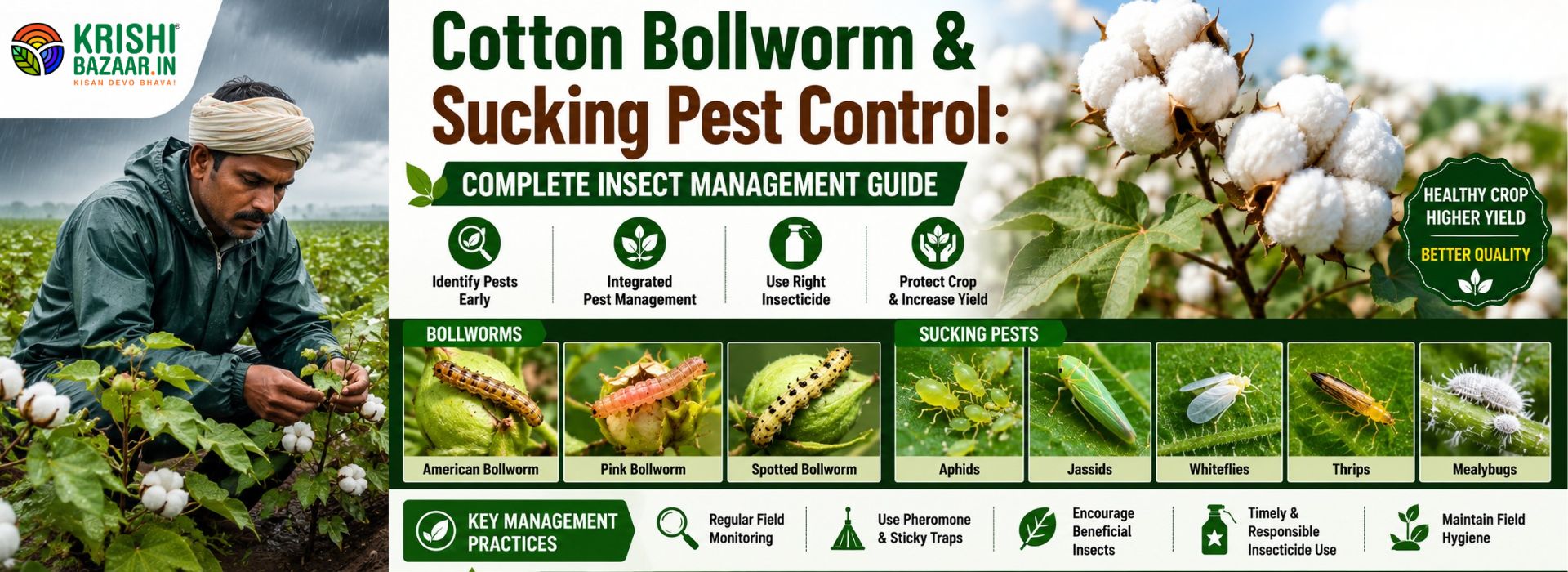
Cotton Bollworm & Sucking Pest Control: Complete Insect Management Guide
August 25, 2026Cotton Bollworm & Sucking
Pest Control: Complete Insect Management Guide
Cotton is one of India’s most
important commercial crops, but its productivity can be seriously affected by bollworms
and sucking pests. These insects damage leaves, squares, flowers, bolls,
and developing cotton, ultimately reducing both yield and fibre quality.
Effective cotton pest management
is not simply about spraying an insecticide whenever insects appear. Farmers
should regularly monitor the crop, correctly identify the pest, protect
beneficial insects, and select suitable crop-protection products based on the
pest and its growth stage.
Major Insect Pests Affecting
Cotton
Cotton pests can broadly be
divided into two groups:
1. Bollworms
Bollworms mainly attack the
reproductive parts of cotton plants and can cause significant yield losses.
Common bollworms include:
- American bollworm
- Pink bollworm
- Spotted bollworm
2. Sucking Pests
Sucking insects remove plant sap
and can weaken cotton plants.
Important sucking pests include:
- Aphids
- Jassids/leafhoppers
- Whiteflies
- Thrips
- Mealybugs
Cotton Bollworm Damage
Bollworms can attack cotton
squares, flowers and bolls. Larvae may bore into developing bolls and feed
internally, making the damage difficult to detect at an early stage.
Common symptoms include:
- Damaged squares and flowers
- Holes in cotton bolls
- Larvae or feeding damage inside bolls
- Premature shedding of squares and flowers
- Damaged developing seeds
- Reduced cotton yield and quality
Pink bollworm is
particularly important because larvae can enter cotton bolls and remain
relatively protected from insecticide sprays.
Sucking Pest Damage in Cotton
Sucking pests are generally found
on tender leaves, shoots and other green plant parts.
Aphids
Aphids suck plant sap and may
cause:
- Leaf curling
- Yellowing
- Reduced plant vigour
- Sticky honeydew on leaves
Jassids
Jassids feed mainly on the
underside of leaves.
Typical symptoms include:
- Yellowing or reddening of leaf margins
- Downward curling of leaves
- Reduced plant growth
Whiteflies
Whiteflies can cause direct
sap-feeding damage and produce honeydew, which can encourage the development of
sooty mould.
Thrips
Thrips commonly damage young
leaves and tender plant tissues, causing:
- Silvery or distorted leaves
- Scarring
- Reduced plant development
How to Manage Cotton Insect
Pests
1. Regularly Monitor the Crop
Regular field scouting is the
foundation of effective pest management.
Farmers should inspect:
- New leaves
- Undersides of leaves
- Squares and flowers
- Developing bolls
- Plant terminals
Look for both insects and
symptoms of damage rather than waiting until the infestation becomes
severe.
2. Use Pest Monitoring Traps
Appropriate traps can help
monitor pest populations and detect increasing pest pressure.
For bollworm management,
pheromone traps can be useful for monitoring adult moth activity. Yellow sticky
traps can also help monitor certain flying sucking pests.
Traps are primarily monitoring
tools and should be used as part of an integrated pest-management program.
3. Encourage Beneficial
Insects
Not every insect found in a
cotton field is harmful. Predators and parasitoids can naturally suppress pest
populations.
Avoid unnecessary broad-spectrum
insecticide applications because they can reduce beneficial insect populations
and potentially cause secondary pest outbreaks.
4. Maintain Field Hygiene
Remove crop residues and manage
volunteer cotton plants according to local agricultural recommendations. Good
field sanitation can reduce opportunities for pests to survive and reproduce
between crop cycles.
5. Use Balanced Crop Nutrition
Healthy cotton plants can
tolerate pest pressure better than stressed plants. However, excessive nitrogen
application can encourage lush vegetative growth and may favour certain sucking
pests.
Use fertilizers based on soil
conditions, crop requirements and recommended nutrient-management practices.
Choosing the Right Cotton
Insecticide
Selecting an insecticide should
begin with correct pest identification.
Consider:
- Which pest is present?
- What is the pest’s life stage?
- How severe is the infestation?
- Is the pest still susceptible to the intended mode
of action?
- Are beneficial insects active in the field?
- What does the product label recommend for cotton?
Farmers should always use only
products registered for the intended crop and pest, follow the
label-approved dose and application method, and observe the specified waiting
period before harvest.
Avoid Repeated Use of the Same
Mode of Action
Repeated use of insecticides with
the same mode of action can increase the risk of insecticide resistance.
A better approach is to rotate
insecticides according to their mode-of-action group, following
resistance-management recommendations rather than simply switching between
different brand names.
This is particularly important
when managing pests such as bollworms and whiteflies.
Integrated Pest Management for
Cotton
The most effective approach is Integrated
Pest Management (IPM).
A practical cotton IPM strategy
combines:
Crop Monitoring → Pest
Identification → Threshold-Based Decision → Biological/Cultural Control →
Suitable Insecticide → Follow-Up Monitoring
Instead of automatically spraying
on a fixed schedule, farmers should make crop-protection decisions based on
pest levels, crop stage and expert recommendations.
Important Precautions While
Spraying
When using crop-protection
products:
- Read the product label carefully.
- Use the recommended dose.
- Wear appropriate protective equipment.
- Use properly calibrated spraying equipment.
- Ensure good coverage of the target plant parts.
- Avoid spraying during strong winds or unsuitable
weather.
- Do not mix products unless the combination is
specifically recommended.
- Follow the prescribed pre-harvest interval.
- Keep pesticides away from children, animals and
food products.
- Dispose of empty containers safely according to
local requirements.
Cotton Pest Management at
Different Crop Stages
Early Vegetative Stage
Focus on monitoring jassids,
aphids, thrips and other sucking pests. Avoid unnecessary pesticide
applications when pest populations are low.
Flowering Stage
The crop becomes increasingly
important for boll formation. Closely monitor sucking pests and bollworm
activity.
Boll Formation Stage
Regular scouting is particularly
important for bollworms, especially pink bollworm. Monitor flowers and
bolls carefully and follow locally recommended management practices.
Boll Development &
Maturity
Continue monitoring pest pressure
while observing all applicable pesticide restrictions and pre-harvest
intervals.
Common Mistakes Farmers Should
Avoid
❌ Spraying without identifying
the pest
❌
Using higher-than-recommended doses
❌
Repeatedly using the same insecticide mode of action
❌
Spraying simply because neighbouring fields are being sprayed
❌
Ignoring beneficial insects
❌
Waiting until severe boll damage appears
❌
Mixing several pesticides without checking compatibility and label
recommendations
Conclusion
Successful cotton insect
management requires early detection, correct pest identification and timely
action. Bollworms can directly damage cotton bolls, while sucking pests
weaken plants through sap feeding. Regular scouting, traps, field sanitation,
balanced nutrition, conservation of beneficial insects and responsible
insecticide use can work together to protect the crop.
For Indian cotton farmers, an Integrated
Pest Management (IPM) approach is generally more sustainable than relying
solely on repeated insecticide sprays. Always follow current local agricultural
recommendations and the approved product label before applying any
crop-protection product.
At krishibazaar.in, you
can find and buy various agricultural products. For agricultural guidance on
selecting the most suitable products for your crops, please contact or WhatsApp
at +917887880887.

Guest reviews
No reviews found for this Blog