

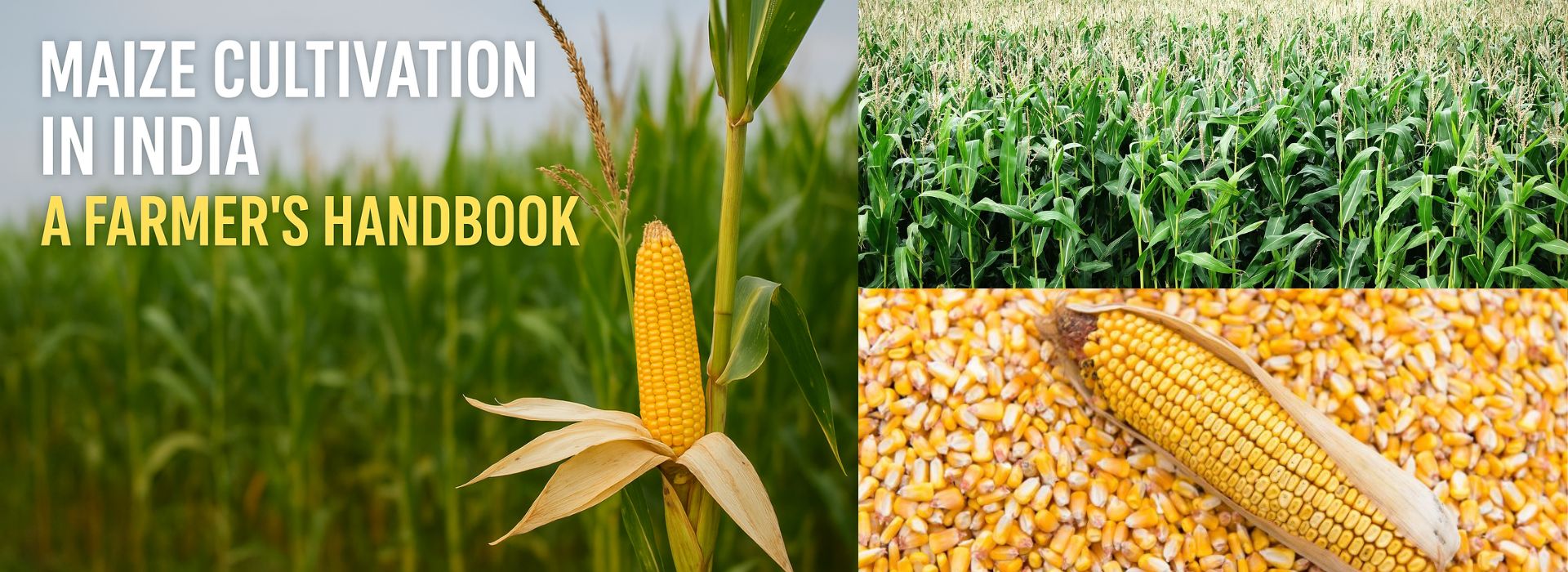
Maize Cultivation in India: A Farmer’s Handbook
September 25, 2025Maize Cultivation in India: A Farmer’s Handbook
Maize, commonly known as corn,
is one of the most versatile crops in the world. In India, it holds a special
place as both a food crop and an industrial raw material. Grown across
diverse regions, maize is used for human consumption, livestock feed, and
industrial products like starch, ethanol, and biofuels.
India is the fifth-largest
producer of maize globally, with major cultivation areas in Karnataka,
Madhya Pradesh, Bihar, Uttar Pradesh, Andhra Pradesh, and Maharashtra. For
farmers, maize offers high profitability if managed with the right practices.
This handbook covers everything from soil preparation to harvesting for successful
maize farming in India.
🌱 1. Climate and Soil Requirements
- Climate: Maize grows well in warm, moist
conditions, with an optimum temperature of 20–30°C. It is
sensitive to frost and drought.
- Rainfall: Requires 50–100 cm of evenly
distributed rainfall. Excess waterlogging can damage roots.
- Soil: Prefers fertile, well-drained loamy
soils with a pH between 5.5–7.0. Heavy clay soils should be
avoided.
🌾 2. Varieties of Maize
Farmers should choose the variety
based on purpose—grain, fodder, or industrial use.
- Popular Varieties:
- Hybrid: Ganga 5, Deccan 103, Vivek Hybrid
9, HQPM-1
- Composite: Vijay, Amber, Jawahar
- Fodder Purpose: African Tall, J-1006
Hybrid seeds are widely
recommended for higher yields and disease resistance.
🚜 3. Land Preparation and Sowing
- Plough 2–3 times to achieve fine tilth and ensure
proper drainage.
- Apply 8–10 tons of FYM/compost per hectare
during land preparation.
- Sowing Time:
- Kharif Season: June–July (with onset of
monsoon)
- Rabi Season: October–November (with
irrigation)
- Summer Crop: January–February in irrigated
regions
- Spacing: 60 cm × 20 cm (row × plant)
- Seed Rate: 20–25 kg/ha for hybrids
🧪 4. Nutrient Management
Maize is a nutrient-demanding
crop and responds well to fertilizers.
- Fertilizer Dose (per hectare):
- Nitrogen (N): 150 kg
- Phosphorus (P₂O₅): 60 kg
- Potassium (K₂O): 40 kg
- Application:
- Basal: 1/3rd N + full P + full K at sowing
- Top dressing: Remaining N in 2 splits (at
knee-high stage and tasseling stage)
- Micronutrients: Zinc deficiency can reduce
yields; apply Zinc Sulphate @ 25 kg/ha.
💧 5. Irrigation Management
- Maize needs 5–6 irrigations, depending on
rainfall.
- Critical Stages of Irrigation:
- Knee-high stage (20–25 DAS)
- Tasseling (45–50 DAS)
- Silking
- Grain filling stage
Avoid water stress during tasseling
and grain filling, as it directly affects cob development.
🐛 6. Weed, Pest, and Disease Control
Weed Management
- Major weeds: Amaranthus, Echinochloa,
Cynodon.
- Pre-emergence herbicide: Atrazine 1 kg/ha.
- Hand weeding at 20–25 DAS is effective.
Pest Management
- Stem borer: Spray Chlorantraniliprole
or release Trichogramma cards.
- Fall Armyworm (FAW): A major pest in maize.
Use Spinosad, Emamectin Benzoate, or biological control methods.
Disease Management
- Turcicum leaf blight: Use resistant
varieties and Mancozeb spray.
- Downy mildew: Ensure seed treatment and crop
rotation.
🌽 7. Harvesting and
Post-Harvest Practices
- Maize is ready for harvest when cobs turn yellow
and grains harden (moisture content ~20%).
- Harvest manually or with corn pickers.
- Dry cobs to reduce moisture to 12–14% before
shelling.
- Store in airtight bins or gunny bags to
prevent storage pests.
🌟 Tips for Higher Maize
Yields
- Use certified hybrid seeds for better yield.
- Adopt ridge planting in areas with heavy
rainfall for better drainage.
- Practice crop rotation with legumes to
improve soil fertility.
- Use drip irrigation to save water and
improve fertilizer use efficiency.
- Adopt Integrated Pest Management (IPM) for
long-term crop protection.
✅ Conclusion
Maize is a highly profitable crop
with applications ranging from food to industry. By following scientific
farming practices—right seed selection, balanced nutrition, timely irrigation,
and integrated pest management—farmers can achieve higher yields and better
profitability. With India’s growing demand for maize in both domestic and
export markets, maize cultivation offers a bright future for farmers.
🔖 Tags:
#MaizeCultivation #CornFarming #CropManagement #IndianAgriculture
#FarmersHandbook
Would you like me to also prepare
a visual maize fertilizer & irrigation schedule infographic for this
blog (easy for farmers to follow step by step)?
At krishibazaar.in, you
can find and buy various agricultural products. For agricultural guidance on
selecting the most suitable products for your crops, please contact or WhatsApp
at +917887880887.

Guest reviews
No reviews found for this Blog