

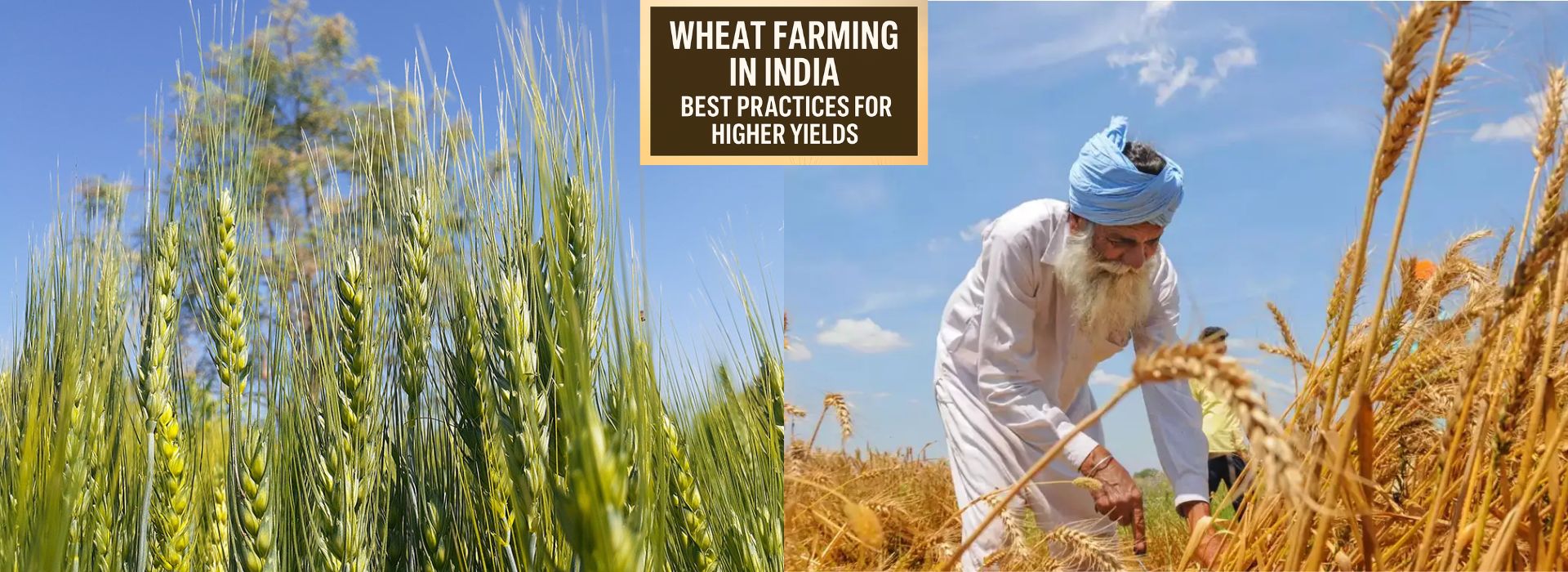
Wheat Farming in India: Best Practices for Higher Yields
September 15, 2025Wheat Farming in India: Best
Practices for Higher Yields
Wheat is one of the most
important staple food crops in India, contributing significantly to the
nation’s food security. With over 30 million hectares under cultivation,
India is the second-largest producer of wheat globally. For farmers, wheat is
not just a crop but a source of stable income, especially in states like
Punjab, Haryana, Uttar Pradesh, Madhya Pradesh, and Rajasthan.
To maximize yield and quality,
adopting best practices in wheat farming is essential. Let’s explore the
key steps to achieve higher productivity.
🌱 1. Climate and Soil
Requirements
- Climate: Wheat thrives in cool, dry
winters and requires 15–20°C during sowing and 20–25°C
during grain filling. Excessive heat at maturity reduces grain quality.
- Soil: Well-drained loamy and clay-loam
soils with pH 6.0–7.5 are ideal. Sandy soils need more organic matter,
while alkaline soils must be treated with gypsum.
🌾 2. Seed Selection
Choosing the right variety
ensures better yield and disease resistance.
- Popular Varieties: HD 2967, HD 3086, PBW
550, DBW 187 (for North India), GW 322 (for Gujarat), MP 1203 (for MP
region).
- Seed Rate: 100–125 kg/ha for irrigated
areas; 125–150 kg/ha for rainfed conditions.
- Seed Treatment: Treat seeds with Carbendazim
(2 g/kg) or Trichoderma (bio-treatment) to prevent seed-borne
diseases.
🚜 3. Land Preparation
- Plough the field 2–3 times to achieve fine tilth.
- Apply 5–10 tons of FYM or compost per hectare
for soil enrichment.
- Ensure proper leveling for uniform irrigation.
🧪 4. Fertilizer
Management
Balanced nutrition is key to
higher yield.
- Recommended Dose (per hectare):
- Nitrogen (N): 120–150 kg
- Phosphorus (P₂O₅): 60 kg
- Potassium (K₂O): 40 kg
- Application:
- Basal: 50% N + full P + full K at sowing
- Top Dressing: Remaining 50% N in two splits (first
at crown root initiation stage ~20 DAS, second at booting stage ~45 DAS).
- Micronutrients: Apply Zinc Sulphate (25
kg/ha) in zinc-deficient soils.
💧 5. Irrigation Schedule
Wheat requires 5–6 irrigations
during its life cycle.
- Critical Stages:
- Crown Root Initiation (20–25 DAS) – most critical
- Tillering stage
- Jointing stage
- Flowering stage
- Grain filling stage
Avoid water stress at CRI and
grain filling as it can reduce yield drastically.
🐛 6. Weed and Pest
Management
Weed Control:
- Major weeds: Phalaris minor, Chenopodium
album, Avena ludoviciana.
- Pre-emergence herbicide: Pendimethalin (1 kg
a.i./ha).
- Post-emergence: Clodinafop or Sulfosulfuron
at 30–35 DAS.
Pest/Disease Control:
- Rusts (yellow, brown, black): Use resistant
varieties and apply Propiconazole spray if needed.
- Termites: Apply Chlorpyriphos 20 EC
at sowing in termite-prone areas.
🌼 7. Harvesting and
Storage
- Wheat is ready for harvest when grains are hard
and golden-yellow (moisture ~20%).
- Use combine harvesters or sickles for harvesting.
- Dry grains to 10–12% moisture before storage
to prevent fungal attack.
- Store in moisture-proof bags in a clean, dry
warehouse.
🌟 Best Practices for
Higher Yield
- Timely Sowing: Optimum window is Nov
10–Nov 25 in North India.
- Zero Tillage: Saves time, moisture, and
improves soil health.
- Integrated Nutrient Management (INM):
Combine organic manure, biofertilizers, and chemical fertilizers.
- Integrated Pest Management (IPM): Use a mix
of biological, cultural, and chemical practices.
- Adopt New Technologies: Use high-yielding,
disease-resistant varieties and precision irrigation systems.
✅ Conclusion
Wheat farming in India has great
potential, but to unlock higher yields, farmers must adopt scientific
practices, improved varieties, balanced nutrition, and timely crop management.
With the right approach, wheat farmers can not only increase productivity but
also improve grain quality and profitability.
🔖 Tags: #WheatFarming
#CropManagement #HighYieldWheat #IndianAgriculture #BestPractices
Would you like me to also create
a visual fertilizer & irrigation schedule infographic for this blog
so that farmers can quickly follow it?
At krishibazaar.in, you
can find and buy various agricultural products. For agricultural guidance on
selecting the most suitable products for your crops, please contact or WhatsApp
at +917887880887.



Guest reviews
No reviews found for this Blog